The 3-Layer Search Strategy Small Businesses Need in 2026: SEO, AEO, and AI Optimization
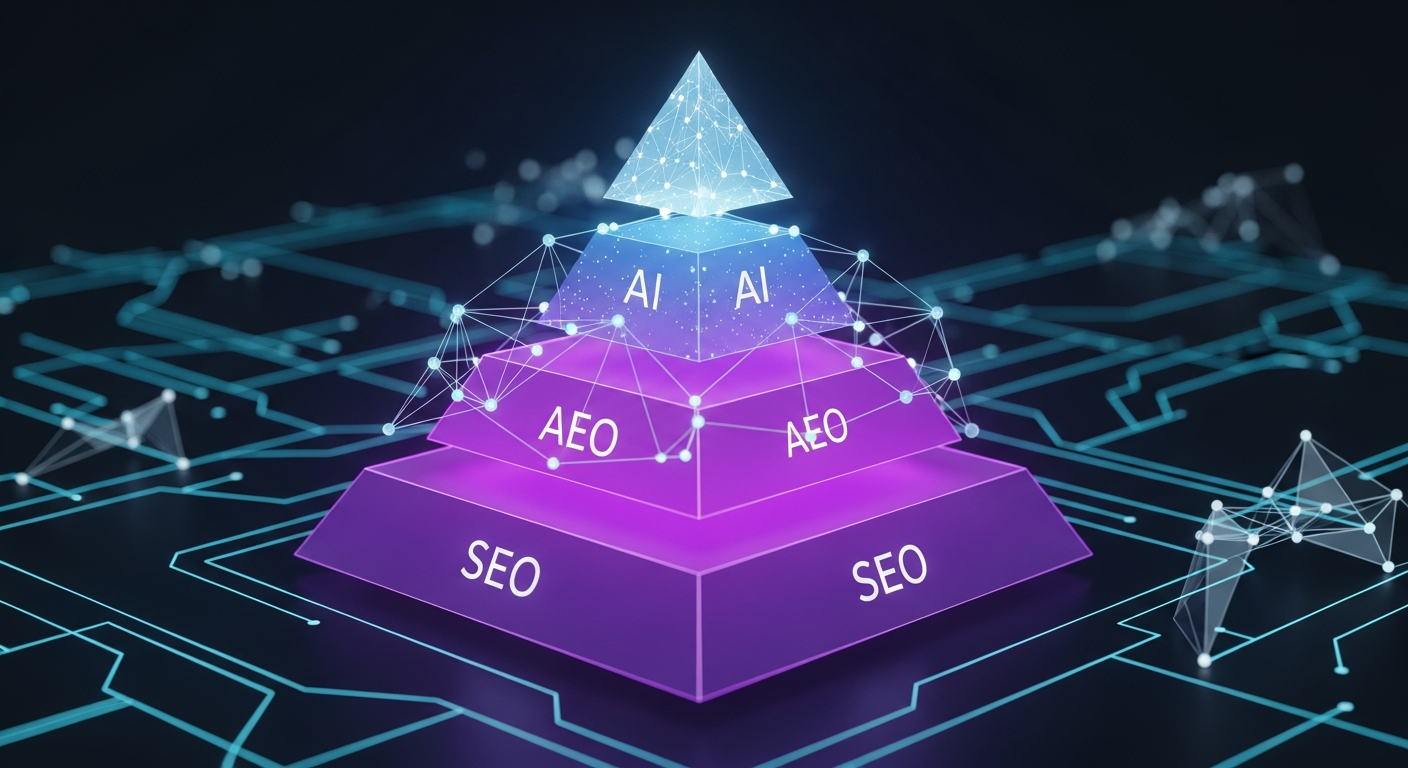
If your entire digital strategy depends on Google rankings, you're operating on one cylinder in a three-cylinder engine. In 2026, people discover businesses through traditional search results, voice-powered answer engines, and AI tools like ChatGPT and Perplexity. Each channel requires a different approach — but they all reinforce each other when done right.
This is the 3-layer search strategy we recommend to every small business we work with at Mahogany Sites. It's practical, buildable without an enterprise budget, and designed to compound over time.
Why Three Layers?
Search behavior has fundamentally fragmented. Consider how your potential clients might find you today:
- Someone searches "web design agency near me" on Google and clicks a result. (Traditional SEO)
- Someone asks their phone "Who builds websites for small businesses?" and Google reads out a direct answer. (AEO)
- Someone asks ChatGPT "What should I look for in a web design agency?" and your brand is referenced in the AI's response. (AI Optimization)
Each of these is a real scenario happening right now. A single-layer strategy misses two out of three potential touchpoints. The 3-layer approach is designed to give you a presence across all of them.
Layer 1: SEO — Your Digital Foundation
Search Engine Optimization is still the highest-volume discovery channel for most businesses, and it's the technical and content foundation everything else is built on. Google remains the most widely used search engine. Getting this layer right is non-negotiable.
Layer 1 Priorities for Small Businesses
Technical Foundation
- Fast load times — aim for under 2.5 seconds on mobile (Google's Core Web Vitals benchmark).
- Mobile-first design — Google indexes your mobile site first.
- Clean URL structures, proper redirects, no broken links.
- An SSL certificate (HTTPS) — a basic trust signal and ranking factor.
On-Page Content
- Each page targets a specific, relevant keyword cluster — not just a single keyword.
- Title tags and meta descriptions are unique, descriptive, and compelling.
- Headers (H1, H2, H3) create clear content hierarchy that both humans and search engines follow.
- Content demonstrates E-E-A-T: real Experience, Expertise, Authoritativeness, and Trustworthiness.
Local SEO (Critical for Small Businesses)
- A fully optimized Google Business Profile with accurate NAP (Name, Address, Phone), hours, photos, and regular posts.
- Consistent business information across all directories (Yelp, Apple Maps, Bing Places).
- Location-specific pages and content if you serve multiple areas.
- Genuine customer reviews — one of the strongest local ranking signals.
Authority Building
- Earn backlinks from relevant, reputable websites — industry blogs, local media, partner sites.
- Publish consistent, valuable content (blogs, guides, case studies) that others want to reference.
- Build relationships in your industry that naturally generate mentions and links.
Layer 1 Goal to track: steady visibility for your core services in your target location, and a complete, accurate Google Business Profile. Track progress in Google Search Console.
Layer 2: AEO — Becoming the Answer
Answer Engine Optimization (AEO) focuses on getting your content surfaced as the direct response to a question — in Google's featured snippets, "People Also Ask" boxes, and voice search results from Google Assistant, Siri, and Amazon Alexa.
Voice search and featured snippets are especially important for mobile and local queries. When someone driving through your city asks their phone for a recommendation, AEO improves the odds that your business is part of the answer.
Layer 2 Priorities for Small Businesses
Question-Based Content
- Research the exact questions your audience asks using tools like Google's "People Also Ask" boxes, AnswerThePublic, or simply typing questions into Google and seeing the autocomplete suggestions.
- Create dedicated FAQ pages and blog posts structured around those specific questions.
- Answer the question directly in the first 1–2 sentences, then elaborate. Don't bury the answer.
Schema Markup (Structured Data)
- Add FAQ structured data on pages with real question-and-answer content to help search engines understand it. Google currently limits FAQ rich results to well-known, authoritative government and health websites (Google Search Central).
- Use LocalBusiness schema to reinforce your location, hours, and services for local voice queries.
- Add Article schema to blog posts with accurate author and publisher information.
Conversational Content Style
- Write the way people speak, not the way people type. Voice queries are longer and more natural.
- Use plain language — answer engines favor clear, accessible explanations over jargon-heavy content.
- Include definitions and explanations for key terms in your industry.
Layer 2 Goal to track: clear, direct answers to your customers' key questions on your own pages, and watch whether they begin appearing in featured snippets or voice results.
Layer 3: AI Optimization — Getting Cited by AI
AI Optimization — also called Generative Engine Optimization (GEO) — is the newest and fastest-evolving layer. It focuses on ensuring your brand and content appear when AI tools like Google AI Overviews, ChatGPT Search, and Perplexity synthesize answers for users.
This channel is fundamentally different from the first two: instead of users clicking to your site, AI tools read and synthesize content and may cite the sources they used. Visibility here is about being recognized as trustworthy, authoritative, and well-structured enough to be referenced.
Layer 3 Priorities for Small Businesses
Depth Over Breadth
- AI models favor comprehensive, accurate content over thin pages. Write thorough guides, not quick takes.
- Cover topics from multiple angles — definitions, how-to steps, examples, pros and cons, FAQs.
- Update content regularly to keep it current. AI tools prioritize fresh, accurate information.
Credibility Signals
- Cite credible external sources in your content. AI tools trust content that references authoritative data.
- Include clear author attribution with relevant credentials or experience.
- Earn coverage and mentions from established industry publications and websites.
Structure for Machine Readability
- Use clear header hierarchies (H2, H3) that help AI models understand your content's structure.
- Write in well-organized sections with direct, factual statements — AI summarization favors extractable, self-contained paragraphs.
- Avoid dense walls of text. Tables, lists, and callouts improve both human readability and AI parsing.
Brand Consistency Across the Web
- Maintain consistent NAP (Name, Address, Phone) and brand descriptions across your website, social profiles, directories, and press mentions. AI tools cross-reference these to verify legitimacy.
- Build a recognizable brand presence — the more consistently your brand appears across reputable sources, the more likely AI models are to recognize and recommend it.
Layer 3 Goal to track: when you ask AI tools about services in your category or location, check whether they describe your business accurately, and fix what they get wrong at the source. No one can guarantee an AI citation.
How the Three Layers Work Together
The beauty of this strategy is that strong work in one layer reinforces the others:
- SEO builds the authority base. Backlinks, trust signals, and technical credibility that you earn for Google rankings are the same signals that AEO and AI tools use to evaluate your content.
- AEO sharpens your content structure. Writing clear, direct, question-based answers to win featured snippets also makes your content ideal for AI summarization.
- AI Optimization amplifies your brand. When AI responses do reference your brand, that awareness can lead to direct searches and visits to your site.
Where to Start: A Realistic Roadmap for Small Businesses
You don't have to build all three layers simultaneously. Here's a sensible sequencing for a small business with limited time and budget:
Layer 1: Fix the Foundation
Audit and fix technical SEO issues, optimize your Google Business Profile, ensure each service page targets a clear keyword, and start producing one piece of quality content per month.
Layer 2: Add AEO Structure
Add FAQ sections to your key pages, implement schema markup, and create dedicated Q&A content around the top questions in your industry. Shift your content writing style toward direct, conversational answers.
Layer 3: Optimize for AI
Deepen your key content pieces, build citation-worthy guides and resources, earn coverage from industry publications, and ensure brand consistency everywhere your business appears online.
Key Takeaways
- Layer 1 (SEO) — Rank in search results. Build technical credibility, optimize for local search, create keyword-relevant content, and earn backlinks.
- Layer 2 (AEO) — Become the direct answer. Structure content around specific questions, implement schema markup, and write in a conversational voice.
- Layer 3 (AI Optimization) — Make your brand easy for AI to understand and reference. Create deep, authoritative, well-cited content and build a consistent brand presence across the web.
- Start with Layer 1. All three layers build on the same foundation — strong SEO makes AEO and AI optimization easier and more effective.
How Mahogany Sites Builds 3-Layer Search Strategies
At Mahogany Sites, we design digital presences that perform across all three discovery channels. From technical SEO and local search optimization to content architecture built for answer engines and AI citations, we help small businesses get found wherever their customers are searching in 2026.
Ready to build a search strategy that works on every layer?
Email: hello@mahoganysites.com
Share this article: